
5 Years In: 'A Better City Exists' Portland + Puget Sound


As we close out the year, it’s a good time to reflect on the work, the partnerships, and the everyday moments that add up to real positive change. At First Forty Feet, our mission “a better city exists” isn’t a slogan as much as a commitment to keep showing up, listening, and helping communities turn shared hopes into places that feel more welcoming, resilient, and alive.
One of the best parts of this year has been watching our work move from drawings to reality. On Main Street in the City of Vancouver, Washington, all of our hard work is being built—turning long-discussed ideas into safer crossings, better public spaces, and a downtown that feels easier to walk, linger, and spend time with the family. We’re especially grateful to the City of Vancouver, Washington for trusting First Forty Feet with the design and planning of one of the community’s most cherished public spaces. It’s a significant public investment—and what matters most is that it’s an investment in people!
After an incredible chapter in PDX Old Town (Portland, OR), First Forty Feet has moved to a new home on Darcelle XV Plaza—right along the City of Portland’s Green Loop. We’re sad to leave Old Town—it’s been our proving ground and our community - but we’re proud of the work we helped advance with the PDX Old Town community. From planning hundreds of new tree wells and trees to shaping a new plaza street, we’ve had the chance to support a more welcoming, green, and people-first downtown.

PDX Old Town will always be part of our story. Moving forward, we can’t wait to watch Darcelle XV Plaza and the City of Portland’s Green Loop take shape in real time - seeing downtown become more livable day by day, for the people who call it home.
We’re also expanding north with a new office in the Puget Sound. After several years of work with communities like the City of Anacortes, City of Snohomish, and City of Tacoma (and throughout the broader Seattle metro), opening a local studio simply makes sense. It gives us a stronger home base to better serve our partners, stay closer to project sites, and deepen our presence across the Pacific Northwest. We also had the opportunity to share our work at the APWA Annual Conference in Tacoma - another sign of how connected we’ve become to the region’s planning and city-building community.

The Heights Civic Plaza: A New Center in East Vancouver
Another accomplishment this year has been our work with the City of Vancouver, Washington on The Heights Civic Plaza—a new civic heart for East Vancouver on the former Tower Mall site, designed to serve five surrounding neighborhoods and anchor future redevelopment in the Heights.

Our guiding question has been simple (and big): How can a place for people reveal the story of the land beneath it—building stewardship in a changing climate? Through engagement, we focused on a plaza that works as both a neighborhood living room and a destination—supporting everyday use alongside festivals, markets, and community events.


A few elements we’re especially proud of include an experience-based “educational landscape” inspired by the Missoula Floods—told through water, topography, paving, and play rather than signage; a central gathering space complemented by smaller peripheral gathering spaces that support rest, informal play, and quieter moments; and a Hidden Animal Discovery scavenger hunt embedded in the paving, where Ice Age species silhouettes invite exploration, curiosity, and repeat visits. Design documentation continues in 2026, with construction anticipated to follow as funding and phasing align.
Investing in People: Silverton's Main Street + Downtown Plaza Vision
In 2025, we were proud to help the City of Silverton set a clear, community-centered direction for Silverton Main Street & Plaza—a placemaking plan that strengthens downtown’s day-to-day comfort while amplifying the energy people already love about Silverton.

The work pairs two big moves: shaping Main Street as a model “open street” for lingering, dining, and events, and designing the civic plaza beside City Hall as downtown’s “living room”—welcoming, resilient, and rooted in Silverton’s history and character. First Forty Feet led the conceptual design and community engagement, in close collaboration with MacKay Sposito providing the engineering expertise to carry the vision forward.

Inspired by Silver Creek and the legacy of local mills, the concept introduces a plaza that mixes park + plaza experiences—flowing paving patterns, native planting, a stage canopy and lawn for performances, a water feature, and a new community anchor (Eugene Field Hall) designed for markets, meetings, and civic life. Along Main Street, widened sidewalks, healthier street trees, safer crossings, and flexible curb zones support parklets, deliveries, and celebrations—reimagining the “first forty feet” from storefront to street as Silverton’s front door.

Rebuilding with Purpose: A Resilience Framework for Pacific Palisades
As we wrap up the year, one project that’s stayed with us is our work in the Pacific Palisades (Los Angeles)—a resilience framework that asks how a community can rebuild with purpose after wildfire and come back stronger, safer, and more inclusive. Working with a client stewarding 130+ acres of fire-damaged land, we helped shape a recovery plan that balances new housing on ~30 acres with habitat restoration and conservation across ~100 acres—repairing ecological damage while planning for long-term resilience.
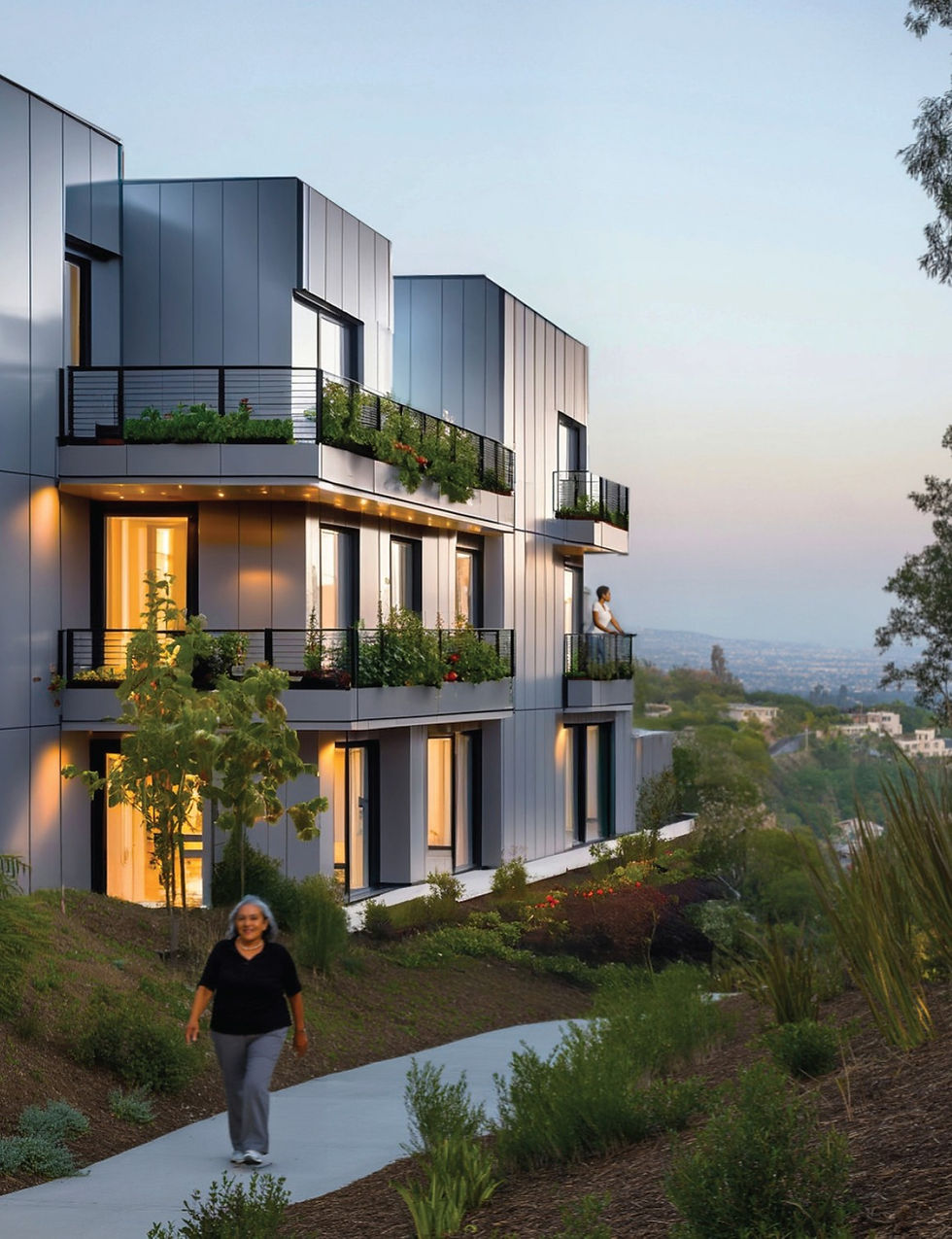
A few big moves we’re proud of include advancing a fire-resilient redevelopment approach with non-combustible Type I/II steel modular construction, paired with emergency-response infrastructure such as water towers and wildfire lookout posts. We also shaped a housing strategy that meets real needs—multi-family, senior, and single-family options—organized to support walkability, shared amenities, and a multi-modal lifestyle. And we centered ecological recovery by restoring native systems through fire-resilient habitat strategies like coastal sage scrub, bioswales, riparian buffers, and habitat corridors, alongside community education and partnerships.

This is the kind of work we want more of in 2026: projects that treat recovery as an opportunity to invest in people, ecosystems, and a safer future in a changing climate.
Honoring Many Stories: Our 2025 Heritage Square Milestone
This year, First Forty Feet completed our work on Heritage Square in Astoria, Oregon (2024–2025) for the Astoria Parks & Recreation Department—reimagining an underutilized downtown site as a functional, inviting public plaza that supports everyday use alongside community gatherings and events. Thank you to the City of Astoria for the partnership and stewardship of this important public place.

A core question guided the process: How do you celebrate “heritage” in Astoria’s main public space without centering on only one group or story? Through community input, an idea emerged to focus on something everyone can share—celebrating each generation’s contribution to building the City of Astoria, especially the generations who helped the city rebuild after devastating fires in its past.

The preferred design brings together the community’s most valued elements: a flexible hardscaped gathering space for performances, glass tiles, decorative lighting and structural features that reinforce resilience, a large garden (including climate-forward intent), a large covered structure, and an extension of the city’s historic timeline—while also improving accessibility, stormwater integration, and pedestrian connectivity.

Tigard Bank & First Forty Feet 'In'
As we close out the year, one small-but-mighty highlight was wrapping up a design study for the historic First Bank of Tigard with Kevin Bates—exploring how this classic brick storefront can become an active, welcoming place again in downtown City of Tigard.

We took inspiration from the building’s story and original character, and focused the concept on bringing back the building’s key cues: a framed entry, full-height window proportions, and historic-style details like reverse glass gilding and blade signage—paired with a refreshed façade ready for a new chapter.

Inside, we explored a warm, character-rich hospitality environment—organized around a central bar and intimate dining rooms—designed to feel timeless, lively, and local.

Our Downtown Revitalization Work Continues
In 2025, First Forty Feet wrapped up our work with the City of Battle Ground on the Old Town Subarea Plan—a practical roadmap for bringing East Main Street back to life while protecting the modest charm and identity that make Old Town feel like Battle Ground.
Built around seven “Big Ideas,” the plan turns vision into block-by-block action—highlighting a future Market Hall at the former Andersen Dairy site, a more welcoming East Main streetscape, and park improvements that strengthen Old Town’s civic heart.

To make it tangible, we also developed the Pacificly You storefront improvement as a case study, showing how simple façade, signage, and lighting upgrades can reinforce character and bring more people to the street.
To close out 2025, we wrapped up our work in City of Sherwood by completing the Old Town Strategic Plan—a clear roadmap to catalyze public and private investment in the city’s historic heart. Grounded in community input, the plan focuses on sense of arrival, business health and growth, and infrastructure and development, with thirteen key actions—including extending the curbless Pine Street design and creating a new “front door” by extending Columbia Street to improve access and unlock redevelopment.

2026
We’re grateful to the partners, community members, clients, and collaborators who made this year possible and to the First Forty Feet team, whose care, creativity, and craft turn big civic ambition into places people can actually use and love. Here’s to 2025—a year of watching big ideas become a reality—and to 2026, when we’ll keep proving (block by block) that a 'better city exists'.
The Heights Civic Plaza
Civil & Structural Engineering, Landscape Architecture: PBS, An Apex Company
Lighting Design: Säzän Group Inc.
Water Feature Design: STO Design Group Inc.
Inclusive Playground Design Consultant: Harper's Playground
Silverton Main Street & Plaza
Civil Engineering & Landscape Architecture: MacKay Sposito
Lighting Design: Säzän Group Inc.
Water Feature Design: STO Design Group Inc.
Heritage Square
Civil Engineering & Landscape Architecture: Otak
Battle Ground Old Town Sub Area Plan
Transportation Planning: Transpo Group
Retail Store Design: Front Door Back
Economic Strategy: Leland Consulting Group
Civil Engineering: MacKay Sposito
City of Sherwood Strategic Plan
Economic Strategy: Leland Consulting Group
Civil Engineering: Harper Houf Peterson Righellis Inc.


