
When Sidewalks Become Playwalks


Bringing Childhood Freedom Back into the Street
For many of us, play started right outside the front door.
Not in a destination playground. Not in a programmed recreation space. But in the street; on sidewalks, driveways, and quiet neighborhood routes where children could ride, wander, invent games, and slowly learn the world around them.
That kind of play offered a particular kind of freedom. It gave children a little independence. It gave them room to test limits, meet neighbors, move through the world, and discover the social life of a place. It also gave parents a different kind of freedom: the ability to let everyday life unfold close to home, in a space that was visible, familiar, and shared.

That is what makes play such an important part of neighborhood design.
It may look small from an adult point of view; a child riding in circles, following a path, noticing water, plants, rocks, or insects. But for children, these are not small things. They are how the world becomes real, knowable, and partly their own.
Fred Rogers said it best:

Today, we think about streets differently.
Concerns about traffic, speed, safety, and visibility have changed how children experience the public realm. In many neighborhoods, play has become something families schedule, supervise, and drive to. The street is often treated less as a place for childhood and more as a corridor to pass through.
But the role of the street in childhood is still important.
The street remains the most immediate public space in a child’s life. It is the space between home, school, parks, neighbors, and daily routines. If we design it only for movement, we miss its deeper civic role. But if we design it as shared public life, it can give children and families some of that freedom back.

That is the idea behind the Heights Grand Loop Linear Park (https://www.firstfortyfeet.com/heights-grand-loop-linear-park)
The project begins with a practical need: the district needs a street. It needs circulation, access, walking routes, bike routes, and connections between future homes, parks, and civic spaces.
But instead of treating the street only as infrastructure, the Grand Loop asks it to become something more generous.
Sidewalks become playwalks.

The everyday path through the neighborhood becomes a place for discovery, movement, learning, and small moments of independence. Children can ride, pause, climb, notice, gather, and explore. Parents can feel that play is close to home, visible, and woven into daily life.
The Grand Loop turns everyday infrastructure into a linear park. It connects the district while creating places to gather. It supports walking and biking while introducing play, planting, wayfinding, and outdoor learning. Through hydrology, ecology, geology, and volcanology, it turns the natural story of the Heights in the City of Vancouver, Washington into a sequence of experiences along the route.
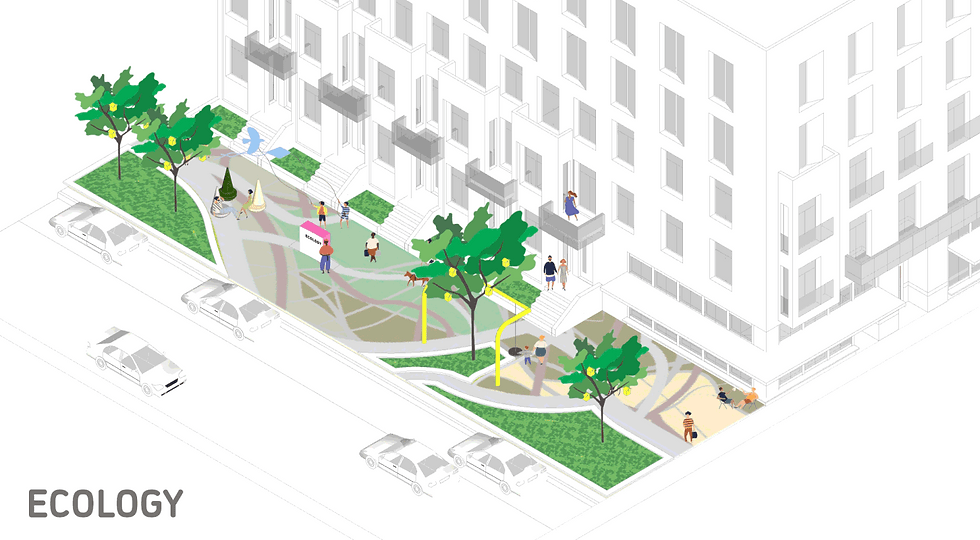
In most projects, play is added after the infrastructure is solved.
Here, play becomes part of the infrastructure.
The design move is simple: take the street the district already needs, and ask it to do more. Let movement become discovery. Let sidewalks become playwalks. Let the public realm become a framework for childhood freedom, family life, and neighborhood belonging.

The Grand Loop is asking how a contemporary neighborhood can give children and families some of that freedom back; with streets designed for safety, visibility, movement, learning, and play.
The answer is not just a playground.
It is a street designed as public life.

This project wouldn't have been possible without amazing partners like Harper's Playground, PBS, An Apex Company, and Säzän Group Inc., among many others.


